This feature was first published on our newsletter, Londonist: Keys to the City.
Sign up for free to get our weekly listings guide straight to your inbox, with our pick of the best free events happening all over the city. There'll also be regular features on surviving and thriving in London, which might include anything from how to get an NHS dentist to mental health resets in a hectic cityscape, and the best places to loiter for free in the city. There's also a paid subscriber option, which unlocks even more — regular bonus posts, free rein to roam through the archives, and other member perks to come.
Dear Ishani,
I have lived in (north) London my whole life. I like your newsletter because it brings the passion and wonder of someone new-ish to the city, who is invested in uncovering the treasures that can be found in its infinite nooks and crannies, but also because it factors the exorbitant and exclusionary costs that come with surviving in the city. My question is: how can one retain this sense of wonder over time, while costs rise, economies collapse, politics destabilise, division mounts, small businesses shutter, clubs close, corporations conquer, Australians move here*, etc?
Best,
Old faithful
*This view does not reflect that of Londonist.
I think this is a perfect question to kick off this segment. You've hit on a bunch of systemic problems that exist, are incredibly hard to handle, and which I hope (though I'm not convinced) entire departments are dedicated to solving.
Reading your question reminded me of the concept of hurry sickness. That's to say, so much bad shit is happening, it's loud and relentless, you have work and non-work duties to do on top of it all, and you want to do literally everything because SO MUCH is amazing (even though so much is also not), but capacity and willpower are thin. That's this city all over, in my opinion, and it can definitely be too much by default, so guardrails are necessary.

In my experience, the key to wonder is slowing down. This isn't novel — many have noticed it, including Eckhart Tolle and Mary Oliver, but it rings true. When I give myself time to breathe, I see cute kids and smiling old people on the bus, street performers that make me reel in awe or grin to myself, and my chicken shop boss man — whom I greet and chat with gratefully. When I'm in a rush or a dissociative state, literally all of those things piss me off: those bratty kids are in my way, the old people go too slow, the tourist crowds are rubbernecking, the chicken is subpar, and every conversation feels like an annoying waste of time, haven't you noticed this isn't Yorkshire and we don't have time for pleasantries?
A recent anecdote: a few days ago I was tearing to Golders Green station and passed an old couple both using zimmer frames. As I went by at a fast walking pace, they called out, "Whoa there, there goes Speedy Gonzales!" and I laughed. Slipping into the fast lane is easy — getting out takes conscious effort, because this city is fast by nature.

So, my generic-but-true advice: slow the fuck down.
Build in whatever barriers you need to do that. Personally, I safeguard one evening a week for myself with no plans, and push as much of my workload as possible into the pre-2pm portion of the day, sometimes starting work in bed at 6am (I'm an early riser; I'm not glorifying the early morning CEO routine here, I'm saying if there are unconventional corners you can push work into, you may want to do that), so I can spend my afternoons floating about at an easier pace. I have had to fight myself down to no more than two things per evening, preferably one (I know this sounds dumb; I am a SERIAL doer). I also make a concerted effort most days to chew my food properly, which I know also sounds silly, but I swear it helps, and it's really easy to forget to.
And I know you might have multiple jobs, children, or care duties, or some myriad of the three and then some, and be thinking: Ishani, what the fuck? I need to work till 7pm, then take care of other things! I also know that wasn't the most London-based answer.
So, to address both those points, here's a list of small, low-commitment ways to build back some wonder around the city. Obviously, it's not prescriptive, feel free to make up your own, but I'd recommend trying to engage in an active appreciation exercise once to twice a week:
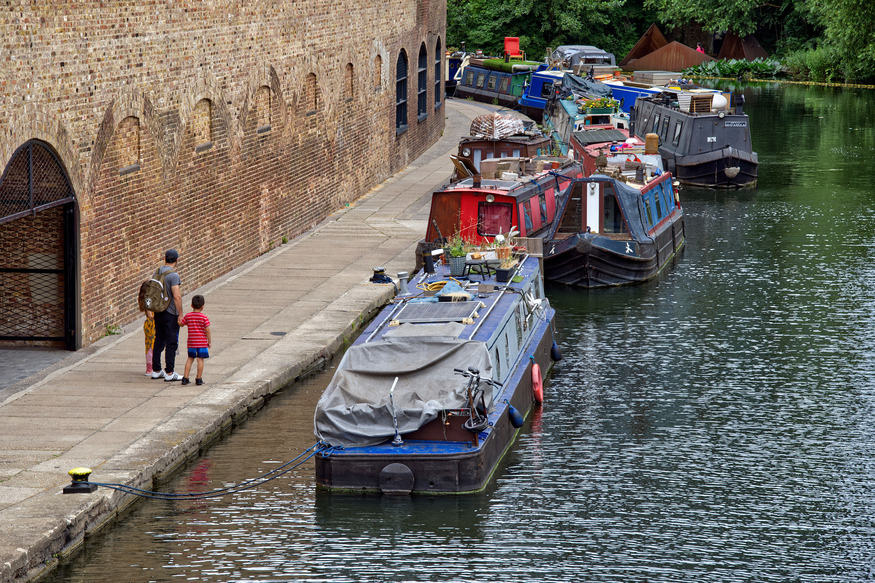
- Walk along Regent's Canal in the springtime. If you time it right (around 9pm near Word on the Water), you can see Canada geese tucking in their goslings which is literally one of the most precious sights on this earth.
- Go to Clissold Park on any morning or early afternoon and watch the baby deer. They're lovely and safely enclosed so they ain't going nowhere.
- Go to Victoria Park on a Saturday morning to observe the sheer number of run clubs. A little anthropology on the side.
- Embrace the potter as a means of whiling away some time. Find a place you like to meander and go at your own pace. Mine is around Islington High Street, where I go greeting charity shop staff and popping into indie bookstores. As a toddler my daily potter was around the village saying hi to cows, sheep, chickens, and a dog — London isn't that quaint, but don't forget about your local city farm if saying hi to the animals appeals to you.
- Read the noticeboard. Check your nearest supermarket or community centre for events or services. Take a photo or note of anything that piques your interest — you might find a community press, decorators, guitar lessons, woodshop classes, theatre calls, yoga sessions, funeral notices for beloved neighbours (all things I found on my last sweep).
- Volunteer occasionally if you can at your local community garden. They are one of the lowest stakes places to volunteer and usually one of the easiest shifts to organise. Council estates often flyer about Saturday morning planting sessions in the autumn and spring which are open to all to just show up and help out. Local papers also bring these up (if you're in north/east, check out Social Spider's publications — they're very good in general, but they also publicise these). Walk by later and see what's grown.
- Speaking of green space, London is one of the greenest cities in the world. Find your nearest park, however small, and sit with a warm drink. Watch out for people, dogs, and birds.
- Make a little sidequest for yourself to try some new things. This one might cost some money, but it can also be as small as you want it to be — to find an ice cream place you really like, the best har gau dumpling within the square mile in which you live, or the comfiest seat in the local library, the best patch of park to lie down in. An example: a sidequest I set myself this year was to befriend some local crows, which meant I had to then walk around my nearby parks and find one that had a pair of crows I could spend time near, which actually took some doing. I am now visiting them regularly in the hope that they start to like me.
- Find a way to capture the city and remember it fondly. Sketch, take photos or write short notes about the places you pass.
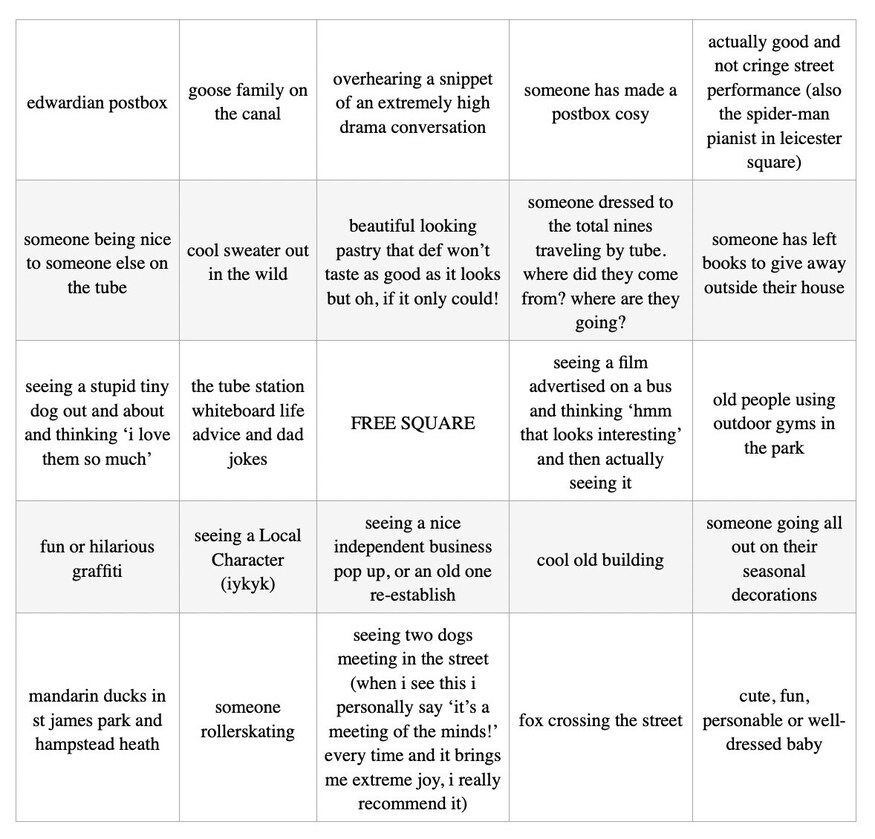
In case it's of any help, I also made you a quick bingo sheet of things I like to notice on the daily. If I notice one of these, or probably a whole bunch of other things, it brightens my day a little bit, and having a similar list of things to bring you joy or tug you out of a bad mood is helpful. It's a busy city, so I probably hit five to 10 micro joys a day if I'm on the lookout, which I try to be. Hope you get a full house!
And one medium-to-high commitment way which may or may not suit your capacity levels, which is: Be the change you want to see. I know, that's so generic and vague! But I do mean the change YOU specifically want to see. That is, if your finances are pressed, start initiating social walks in the park or potluck soup evenings or movie nights or card games around the table.
If you're not seeing your community engage politically in a way you find satisfying, do a litter pick (if you contact your council they will lend you some picks and high vis), run a block party, volunteer at your local food project, run a sesh at your community centre teaching middle aged people how to donate e-sims to Gaza, help kids learn to fix bikes or write stories, do something creative to raise money for a cause of your choice (which includes fundraisers for places that are trying to stay open). Go to your local volunteer action centre and see where you can get involved. I'm not saying we can completely resolve late stage capitalism here — but there are ways to both get respite from it and fight back at it. You would be surprised at how far you can get just by asking 'What can I do about this thing I'm mad about?' earnestly. Not far enough. Never far enough! — but far enough to feel a little better and get a sense of balance.
Overall: I think building wonder is really the art of noticing, and noticing is a practice. it can be very easy to get suckered into thinking that it's about going to everything and doing the most. And I guess it could be, for some people? But for me, it's about finding the 'hey, cool!' in what's already going on, no matter how high or low stakes. If I tried to do everything, I'd literally have to go to hospital. xxx

.jpg)