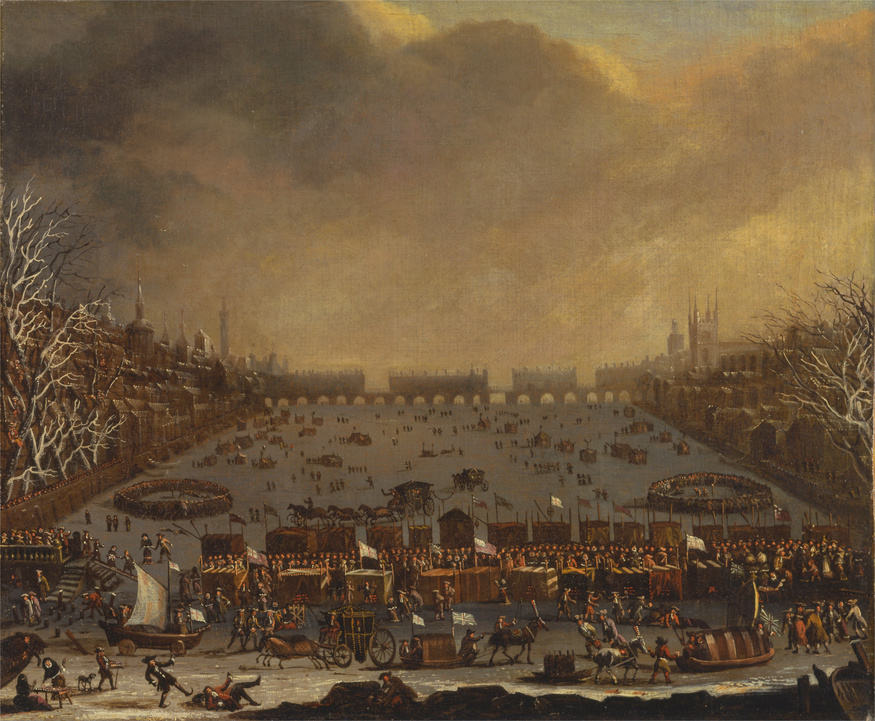
1607-1814: Seven major frost fairs are held on the Thames, which is prone to freezing over during cold snaps, sometimes for two months at a time. This is London's 'Little Ice Age', a period of frigid winters; plus the Thames is wider and slower at the time — as well as the medieval London Bridge having piers that traps ice. The frosty bacchanals — hosting football matches, bowling, pubs and ice skating galore — go down in London lore as some of the most extraordinary parties the city has ever seen. During the final frost fair in 1814, an elephant is paraded on the ice to demonstrate just how thick it was (the ice, not the elephant).
December 1843: A Christmas Carol is published — littered with references to snow, snowball fights and an ice slide, which Bob Cratchit makes use of no less than 20 times in a row, the maniac. As a child, Dickens experienced a number of white Christmases — indeed, he might have witnessed the final frost fair in 1814 as a very young child. His festive novella goes a long way in cementing the idyll of a snow-dusted London over the festive season, even though this rarely happens in real life.

September 1907: A production called The Avalanche is staged at the Hippodrome, featuring an alpine set of 'glistening snow' and 'thick ribbed ice', down which skiers and tobogganists glide, before *spoiler alert* there's an avalanche. "It is not the language of exaggerated eulogy," eulogises the Morning Advertiser exaggeratedly, "to say that a more impressively awe-inspiring tableau has never been witnessed within the four walls of any theatre."
March 1916: A snowball fight gets out of hand, when police constable Oliver Charles Cousins arrests a cab driver for refusing to desist from throwing snowballs in a 'dangerous' manner in Camden Town. A crowd then piles on the constable, pelting him with snowballs till he bleeds. There is however, a twist to the tale: onlookers say the constable himself had been partaking in a snowball fight with a group of women before the incident. "It was all over a game of snowballs," says the taxi driver accused of the policeman, "He lost his temper. He was in it."
December 1926: A Haymarket basement is filled with artificial snow and turned into the London Ski School. "The first thing discovered by those who really set out to become efficient ski-runners," says the Evening News, "is that many falls must be endured in the glittering soda-composition 'snow'". Some 63 years later, a toxic spoil heap in Beckton is turned into an artificial ski slope, visited by Princess Diana and champion skier Franz Klammer.
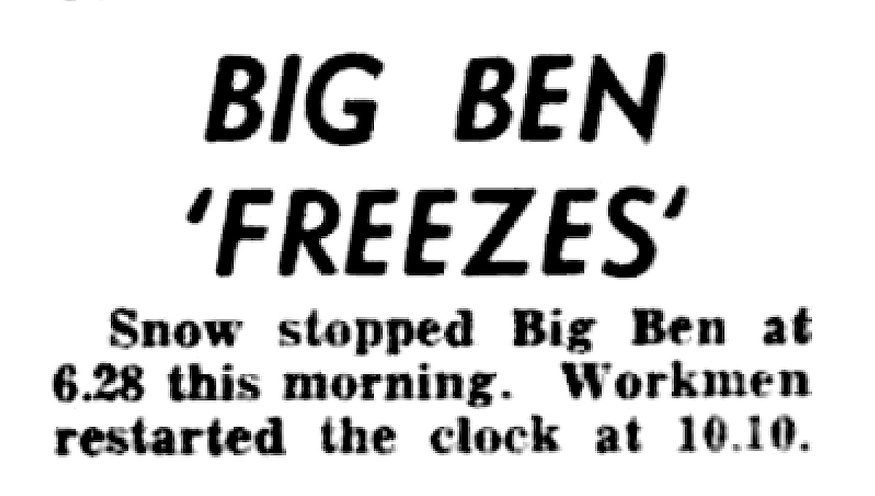
Numerous occasions between 1945-1987: London sometimes becomes so arctic that the clock face on Big Ben freezes stiff — a phenomenon we've written more about here. Claims the Peterborough Evening Telegraph in 1987, "the clock now goes 'clunk' instead of dong!"
25 January 1947: Attempting to take off from Croydon Airport in the snow, a Spencer Airways Douglas C-47A Skytrain crashes into a stationary plane, killing 11 passengers and one crew member. Snow and frost on the wings are cited among the causes of the crash.
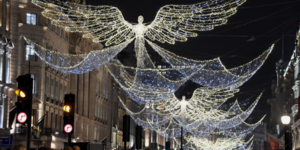
November 1955: Regent Street unveils London's first public Christmas lights in 1954, but the following year sees the city's first ever cross-street decorations — also on Regent Street. They're themed on a snowstorm, featuring glimmering snowflakes, illuminated by recycled aircraft landing lights.
1958: London Zoo's head keeper is given a helping hand trunk clearing the snow, by Rusty the elephant — a moment documented in Hoxton Mini Press' wonderful 2021 book London in the Snow. Needless to say, you can't use elephants to clear snow these days.
1962-3: From mid-December 1962 to early March 1963, Britain suffers some of its coldest temperatures in 200 years, thanks to the 'Big Freeze'. In London, the Trafalgar Square fountains freeze over and a milkman in Earl's Court is photographed making his round on skis.
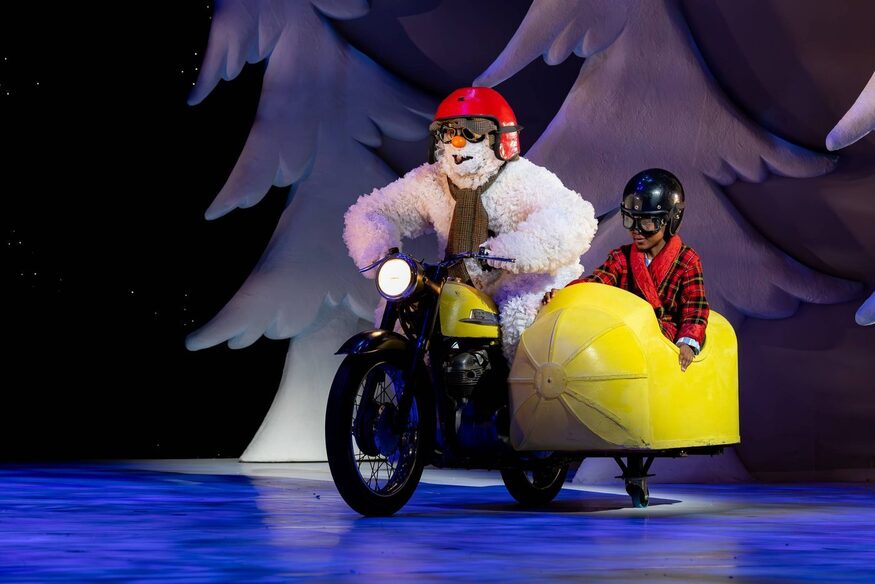
December 1997: The Snowman stage show is first performed at the Peacock Theatre in Holborn, having debuted a few years earlier in Birmingham. It's based on the classic tale by Wimbledon's Raymond Briggs, originally published in 1978. To this day, The Snowman is performed at the Peacock Theatre every Christmas.
25 December 1999: London's last white Christmas to date. This is no snowstorm, but a mere sprinkling of snowflakes above the London Weather Centre. Still, that's enough for those who've had a flutter on the 50-1 odds to make a killing. Says William Hill spokesman Graham Sharpe: "Earlier this week forecasters told me snow was as likely as aliens landing on the Millennium Dome. That's the last time I listen to them."
2008 and 2009: In 2008, London experiences its first flurry of October snow since 1934. In 2009, things get serious; the heaviest snowfall in 18 years paralyses bus, Tube and train routes. The freezing temperatures even cause Eurostar trains loaded with passengers to get stuck in the Channel Tunnel overnight.
2013: A huge inflatable PVC snow globe is built around Eros in Piccadilly Circus, for the festive season. It's not just there for festive magic, but to protect the statue from pissed-up vandals.