On 15 March 1932, the BBC's Broadcasting House transmitted its first radio broadcast — hailed by the press as "the brain centre of modern civilisation". Over 90 years later — and with the help of some serious cosmetic surgery — it's still going strong, having piped everything from King George V to The One Show into millions of households up and down the UK.
A new home for the BBC
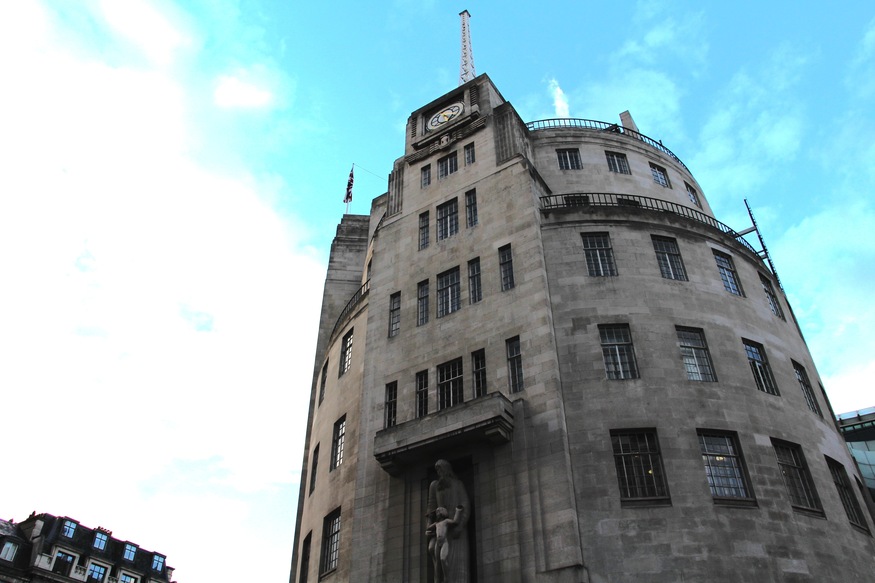
Founded in 1922, the BBC's first broadcasts were made from Savoy Hill, just off the Strand, where the likes of HG Wells and George Bernard Shaw sank whisky and sodas while they spoke from studios that felt more like a gentlemen's club. Under the Beeb's first Director General John Reith*, a vision for a purpose-built headquarters was proposed. This was to be Broadcasting House, where Fitzrovia meets Marylebone.
An old John Nash building was toppled to make way for the art deco confection, which was designed by George Val Myer and took on a curious barrel/tiered cake-like form, owing to the shape of the land it had to squeeze into.
"Broadcasting House has a wonderful way of hoving into view from behind All Souls Church, like an unexpected ocean liner," said Patrick Wright in this 1997 documentary. The architectural critic Jonathan Glancey, meanwhile, described it as a 'Jekyll and Hyde' building — the calmness of the curved offices on the exterior of the building juxtaposed with the sweaty chaos of the small, windowless studios in the meat of the building. No wonder Broadcasting House was the first building in London to have air con.
The original studios were, nonetheless, dashing feats of deco, helmed by the young Australian designer, Raymond McGrath. There was even a mock chapel, from which religious broadcasts were made. Alas, complaints about sound leakage from studio to studio, and pianos not fitting through doors meant that alterations were being made almost as soon as the building was completed. Some say these alterations have never really stopped.
*"I hadn't the remotest idea as to what broadcasting was," Reith later recalled. He was also chairman of Imperial Airways, without having the remotest idea about flying. Which give some credence to the old 'fake it till you make it' saying.
The first Broadcasting House broadcast
Broadcast House's first broadcast took place on 15 March 1932 — two months before the building officially opened, and while construction work was still going on. The broadcast was from bandleader Henry Hall and the BBC Dance Orchestra, who kicked off with It's Just the Time for Dancing, a tune which Hall continued to play regularly until Billy Ternent took over in 1939.
A journalist at the Era wrote of Hall's inaugural broadcast "We like to take our pleasures 'straight' in this country, as we do most other things, and congratulations are due to Mr Hall on his broadcasts of the 'straight' dance music." The piece then took a dark turn: "Many of our present troubles began when we allowed so much of popular entertainment and recreation to be corrupted by the jungle imbecilities and frenzied barbarisms that pass under the general name of 'jazz'".
Hall continued to conduct regularly at the BBC and didn't miss a scheduled broadcast in 32 years, until it came to his 879th appearance. "I feel almost angry," said Hall, "that it is nothing worse than a common cold which has broken my record."
One of London's most controversial statues
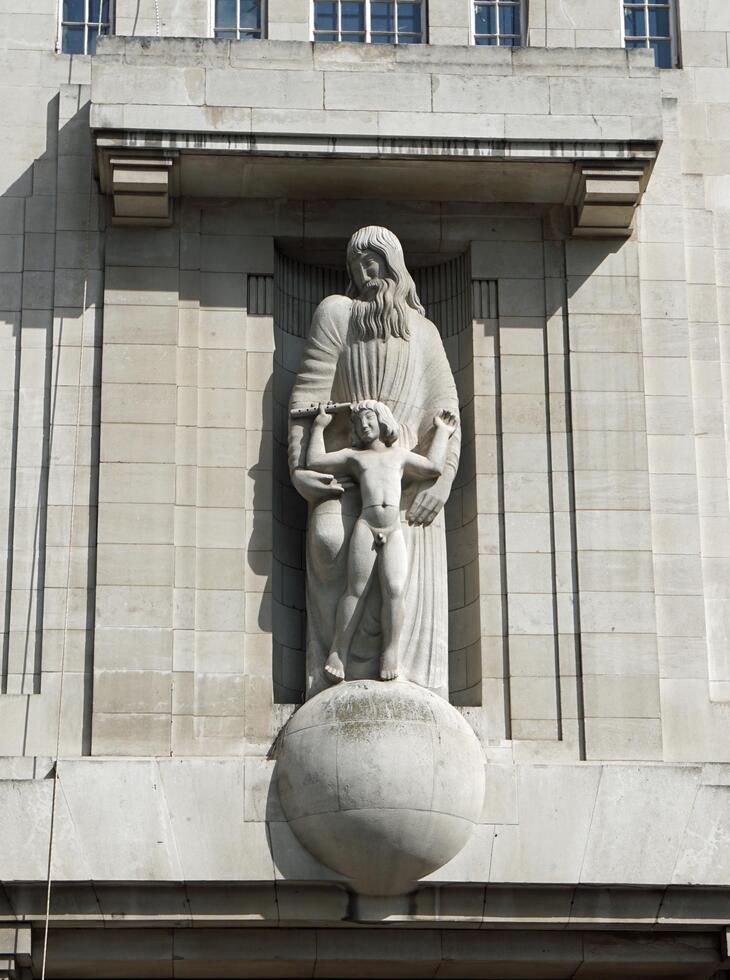
Above Broadcasting House's main entrance perches one of London's most controversial sculptures; Eric Gill's Prospero and Ariel depicts a naked, child-like Ariel from Shakespeare's The Tempest, being held by the magician Prospero (although it's thought that what the Catholic Gill had actually decided to depict was God the Father and God the Son).
Gill carved the statue in situ on scaffolding behind a curtain (allegedly he wore no underwear beneath his smock), and just ahead of its unveiling, the BBC governors sent a man up to take a gander. Taking one look at Ariel's penis he declared "In my view this young man is uncommonly well hung". Gill was ordered to reduce the offending member by an inch and a half. The story's all very chucklesome until you learn that the posthumous release of Gill's diaries revealed he was a paedophile who sexually abused his daughters and family dogs. In 2022, the statue was attacked by a protestor with a hammer. The BBC has since restored it.
More sculptures
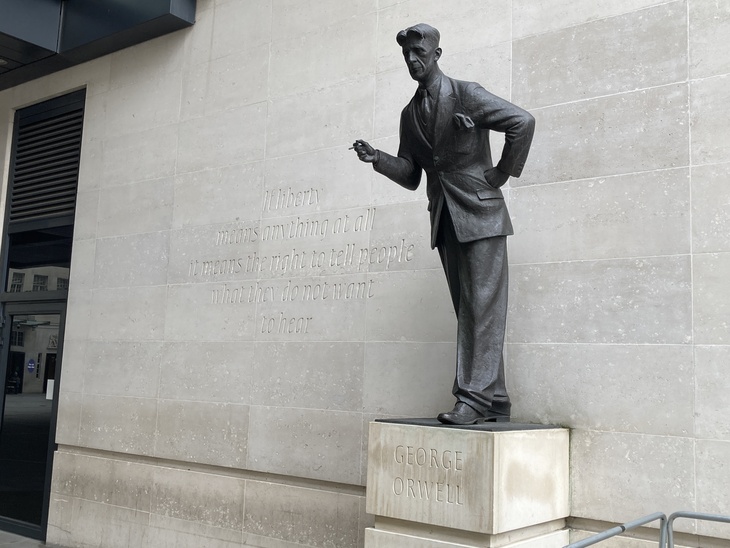
Another sculpture out front — and not without its own controversy — is Martin Jennings' life-sized depiction of George Orwell, one of the most famous figures to work at Broadcasting House, certainly in a producing role.
Orwell produced the Eastern Service between 1941-3. However, his time at the BBC wasn't a cherished one: "For some time past I have been conscious that I was wasting my own time and the public money on doing work that produces no result…" wrote Orwell in his resignation letter. Even many years later — when a statue of Orwell was mooted — some BBC top brass were finding Orwell's tenure hard to swallow, saying he was too contrarian to warrant the honour.
These naysayers didn't get their way though, and the statue was unveiled in 2017. As the Animal Farm quote behind the likeness of Orwell says: "If liberty means anything at all it means the right to tell people what they do not want to hear."
An often overlooked sculpture is the Breathing memorial, which sits atop Broadcasting House's Peel wing, and commemorates those who've lost their life in the field of BBC journalism.
Death at Broadcasting House
The building had only been open a couple of years, when there was a murder here. Well, a fictional one, anyway. The 1934 novel — and film of the same name/year — Death at Broadcasting House is a humorously dark murder mystery which kicks off with the delightfully hammy scene above. It was co-written by Eric Maschwitz, who penned the lyrics to A Nightingale Sang in Berkley Square.
What's been broadcast from Broadcasting House?
Despite its redoubtable name, not all BBC shows are broadcast or recorded at Broadcasting House — many going out from Alexandra Palace, Television Centre, Maida Vale, Bush House and the like instead. However, Broadcasting House biggies include:
- King George V's address to the Empire in 1932
- Desert Island Discs, which first aired on 29 January 1942 (though it was originally broadcast from a bomb damaged Maida Vale studio in north London)
- From 1942, Una Marson, the first Black woman to be employed by the BBC, broadcast Calling the West Indies, from here
- Woman's Hour's first outing was in October 1946 — like Desert Island Discs, a show that's stood the test of time, and then some
- Radio 1 — the Smashey and Nicey tones of Tony Blackburn first hit the airwaves from Broadcasting House on 30 September 1967
- David Bowie's Live at the BBC gig was recorded in the BBC Radio Theatre in 2000
- Not many TV shows are shot at Broadcasting House, other than the news, but The One Show is an exception. It made its debut in Birmingham in August 2006, but later upped sticks to Broadcasting House.
The glass extension
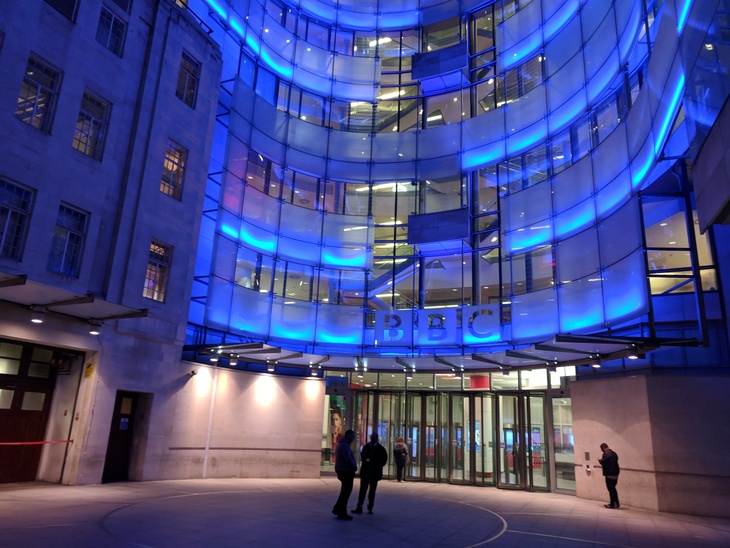
Though the original Broadcasting House has been around almost a century, most of the complex is only a fraction of that. In March 2012, Broadcasting House opened an extension that was four times the size of the original Broadcasting House.
Wrote Rowan Moore in the Guardian at the time "Intended to last 30 years, it is being completed at a time when no one is very sure whether the BBC, or indeed television, will still exist that far into the future." For all of its critics, the extension quickly became an icon of the BBC — its U-shaped court featuring in various BBC idents, and more importantly, the opening credits to This Time With Alan Partridge.
The new Newsroom was opened in 2013, promoting a surreal moment in which Her Majesty photobombed a live news broadcast. "That is one of the most bizarre bits of television that the BBC has produced for some time," said a voiceover.
A building with its own sitcom
This Time With Alan Partridge isn't the only comedy to be based in Broadcasting House. W1A ran for three series from 2014-17, featuring Hugh Bonneville as a discombobulated. Brompton bike-wielding Head of Values, who's drowning in a sea of marketing jargon and airy-fairy halfwits. During filming of series three, a huge 'Floor 6' sign was erected for filming, with a note for BBC employees taped to it saying 'This is floor 4. The number 6 is here for filming purposes only'. As one sensible person pointed out: "Why don't they do the filming on floor 6?". How very W1A.
Dodgy lifts
The lifts in the original Broadcasting House were apparently at one time the fastest in London. The flashy glass lifts in the new extension, on the other hand, are possibly the dodgiest. In 2022, Michael Gove got stuck in one for 30 minutes. That was nothing compared to newsreader Ben Brown, who the same year, was trapped for three hours, and was driven to the brink of insanity by Radio One, being piped through the lift's speakers.
How to get into Broadcasting House
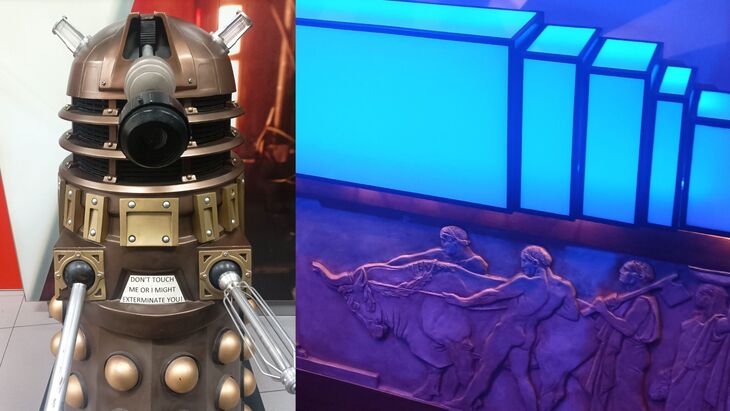
At time of writing, there are no public tours of Broadcasting House, but there are still a couple of ways you can get in. The best is to apply for free tickets to shows recorded in the beautiful BBC Radio Theatre. Not only does this give you an hour or two of free entertainment in a splendid venue, but you can get a drink at the bar beforehand where you can see an EastEnders Queen Vic bust and a Dalek bearing the caveat "Don't touch me or I might exterminate you".
The bar overlooks the BBC Newsroom, and last time we were there, we sat drinking a glass of wine while watching Huw Edwards working at his computer, which goes to show we haven't been for a while now. Failing that, there's a pretty good virtual tour which takes you to some of the key areas, including the BBC Newsroom.
For more on Broadcasting House, we recommend this BBC documentary from 1997.