Alex Fraser"I've Been Painting All Of The Thames Bridges For 10 Years"
Tower Bridge. My project started in 2017 when I started to make little pen and ink sketches of all the bridges. From these original studies my collection grew! I use blue/black ink which when mixed with water 'bleeds' into lighter colours.
I am trying to create a feeling of timelessness, of times gone by, remembering those that have passed by and over the bridges on their way to work or play.
Chiswick Bridge. I started etching in 2018. Frequently when I had just sold a painting I would be asked by someone "can you not just do another like it?" This is easier said than done. However, once a plate is produced one can reuse it to create a number (editions) of prints. The prints vary a bit depending on the type of ink used and application but fundamentally the image is the same. This is a strong etching depicting a structurally sound concrete and stone bridge!
I have always loved a view of a river meandering through a landscape, and about 10 years ago thought it would be fun to look at the River Thames in London and all its crossing points. I didn't realise there were 33 of them...
Richmond Bridge. The oldest surviving bridge in London was constructed in 1777. The bridge was designed as a stone arch bridge supported by five elliptical arches of varying heights. The tall 60ft wide central span was designed to allow shipping to pass, giving the Bridge its distinctive humpbacked appearance. I have painted this ancient bridge on a wooden panel to try to convey its age.
One bright morning in October, after the school drop off, I started.
Blackfriars Pillars. A detail of the beautiful redundant pillars at Blackfriars. My first ever bridge etching. Portrait not landscape!
I drove to Twickenham and walked up and down the river from the beautiful Richmond Lock Bridge, past Twickenham Bridge, Richmond Railway Bridge and then Richmond Bridge. The oldest bridge in London. I took lots of photographs and went home and made a few sketches.
Twickenham Bridge. This is a detailed painting which actually depicts three bridges: Twickenham Bridge in the foreground and then Richmond Railway Bridge and Richmond Bridge through its arches. I love the old ironwork railings alongside the bridge and the contrast between the dark red rust and pale blue paint. The depiction of the railings helps the eye to move through the painting as if on a journey.
The next day I did Putney Bridge, Fulham Railway bridge and Wandsworth Bridge and so it went on. It took about three months.
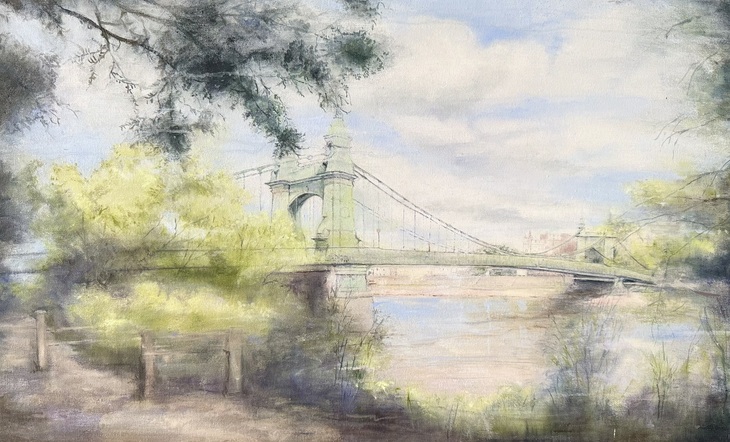
Hammersmith Bridge. One of my favourite bridges, a road bridge for nearly 200 years but now it seems as if the recent restoration means that for the near future at least it is only open to pedestrians and cyclists. Following advice from English Heritage the bridge was repainted green in 2000 in accordance with the designer Bazalgette's original plan. It is a difficult colour to depict and changes in different lights. Here in springtime it appears fresher than in some of my other paintings. I love the way that the bridge emerges from the greenery, looking so safe and serene amongst its surroundings.
Once I had my source material I made pen and ink sketches of all the bridges. In tandem I started to paint them. I had already painted Hammersmith and Barnes Bridges; they are the closest to where I live and I love them.
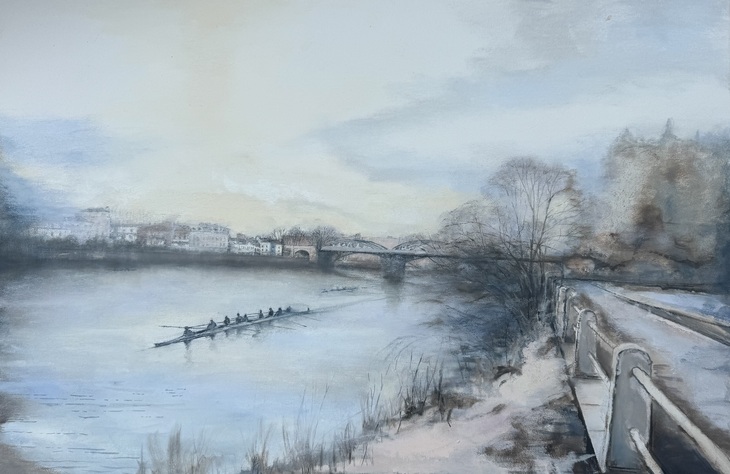
Barnes Bridge with Rowers. This attractive railway bridge was originally constructed during 1849 in accordance with a design produced by the civil engineer Joseph Locke and consisted of two pairs of cast iron arch spans. During the 1890s, a wider replacement bridge, which was designed by Edward Andrews, was constructed by Head Wrightson on behalf of the London & South Western Railway. This structure, which was built directly alongside its predecessor, comprises three spans of wrought iron bow string girders. A pedestrian walkway was also added to the bridge at this time. The bridge is well known for the annual Oxford and Cambridge Boat Race and here I have painted it in the distance during a race in late February. It was a cold day and the cool colour palette that I have used echo the colours alongside the riverbank and in the sky and background of the terrace.
I knew from my time at Wimbledon Art Studios that some views are more popular than others and people ask "Can you not just paint another one?". This is easier said than done, so with that in mind I started an etching course.
Chiswick Mall Low Tide. This is a contemplative study of the River Thames from Chiswick Mall at low tide. It shows the Barnes towpath and trees surrounding the Leg of Mutton Reserve on the left and the beautiful patterns in the foreshore on the right.
This has been a revelation for me. My composition of an image has improved and I have loved paring down the views into three tones.
Richmond Lock. This is a detailed depiction of this beautiful bridge. It was the first bridge that I visited when I started this project. Although having lived in London since the early 80s I was stunned to come across this bridge whilst walking alongside the towpath in late 2016. The fine brushstrokes used to capture the beautiful ironwork contrast with the looser rendering of the foliage which clearly sets it in a rural setting. Through the arches the span of Twickenham Bridge and Richmond Railway Bridge can be seen, thereby taking the viewer on a journey further along the river.
I etch on steel and am very painterly in the way I approach my work. The result is 33 images that I can reproduce.
Albert Bridge. Originally designed and built by Rowland Mason Ordish in 1873 Albert Bridge has been structurally strengthened and is one of only two Thames road bridges in central London never to have been replaced (the other is Tower Bridge). Originally designed as a toll bridge its old tollbooths remain in place, and are the only surviving examples of bridge tollbooths in London This bridge is most people's favourite. Here I have painted it on gesso board. This surface is beautiful to paint on; it absorbs the paint in a similar way to canvas but it is not so forgiving. The thin layers of paint that I have applied over the fine detail of the bridge give an ethereal, timeless quality.
See Alex's bridge paintings at Hayles, Church Road, Barnes from Thursday 5 June-Thursday 19 June 2025, free. The paintings are also available to buy.