 Philip Glass, Gandhi, Martin Luther King, radicalism, puppetry, and, er, farming - the English National Opera seems to have it all in their production of Satyagraha, so drawing the crowds in shouldn't be a problem. Keeping them there, however, is another matter...
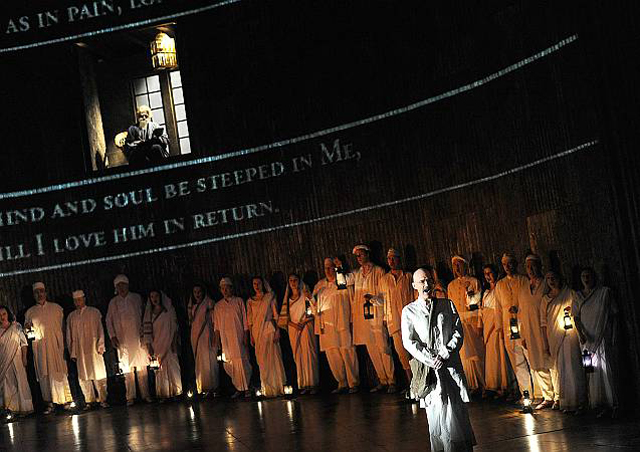
Performing an opera in Sanskrit without subtitles - save for the occasional key phrase projected onto the set - was always going to be divisive. The promise of Phillip Glass' score, along with the stunning set design by the Improbable theatre company (who also directed the production), tips the scales in the opposite direction though. From the outset the constantly fluctuating array of scenery does not disappoint, as creatures emerge from the darkness surrounding what once appeared to be an empty stage, and puppets are constructed from what seems like thin air to tower over the stage. Later on, yet more puppets are introduced which are made from the same newspaper which is integral to the set - and the plot - and seem somewhere between Where The Wild Things Are and Spitting Image (there's definitely a Prescott and maybe a Straw lurking amongst the cast). Unlike the Anthony Minghella production of Madame Butterfly which took place over the summer though, these visuals are built for the medium of the theatre rather than the cinema, and engage the audience with new surprises at every scene.
Following the plot when relying purely on the visuals and the score though demands a lot from the audience, and a working knowledge of Gandhi's early years in South Africa would save spending the first act in a perpetual state of head-scratching. Glass' score is acoustically addictive, yet varies little in key, tone or tempo when changing from the quiet aspiration of his life on Tolstoy's farm to the riots scenes in Durban, and thus conveys little of the drama of the narrative. Perhaps Sanskrit doesn't lend itself to the open vowels which would allow a richer variety of sound. Thankfully the first interval provides opportunity for those who didn't want to fork out the £5 for a programme to repent of this mistake and figure out what the hell is going on. We were not alone in our confusion it seems, although we nearly might have been, since during the interval half of the audience (and by act 3 a significant chunk of the orchestra) had left. Unfortunately for them, the later acts are far more coherent - whilst Gandhi's links with Tolstoy may not be well known, his return to Durban, his rescue by Mrs Alexander, and the ensuing protests are conveyed powerfully, and parallels with the work of Martin Luther King are more straightforward to comprehend.
In the culminating act, MLK dons a suit to gesticulate over a podium in what seems the same manner as a bookie at Antree, in what is otherwise a stunning combination of shadowplay, music and the protagonist’s aspiration. Unfortunately, despite the Alan Oke's rich yet seemingly effortless vocals which interplay beautifully in his solos with the orchestra, the length of the scene adds little to the plot, and the mind wanders (in much the same way as the departed audience members).
The highlights of this production are the use of sky hooks and sopranos, shadows and spindly stilts. In much the same way that it was in Gandhi's life, the printed word is integral to the set and to the narrative. In this vein, remember to buy a programme.
At the London Coliseum, tickets £16 to £50. Runs until 26th March
Watch out for Remix this Sunday, when audience members are invited to bring a musical instrument or a set of vocal chords for the chance to create a series of unique sound loops to form a new soundscape for the evening in collaboration with New York-based musicians Sam Godin and Falu, British composer Anna Meredith, performance poet DJ Charlie Dark and a quartet of classical Indian musicians and VJs from Maskomi.