If anybody knows the modern Varsity Boat Race first hand it is Simon Harris, a competitor with Cambridge in 1982 and 1983, then, as umpire, the man in charge of proceedings in 2000, 2002 and most recently in 2006. He's not centre stage this time around, that honour falling to John Garrett, but on the eve of the 2008 event, set to be followed once again by millions around the world, he spoke to Londonist about the role of the umpire in this classic sporting encounter.
How is the umpire selected?
We have a panel of six potential umpires, three from each boat club. The choice of umpire from the panel alternates between each club. In even years it is Oxford who will select the umpire from the three Cambridge boat club members on the panel.
What is the remit of the umpire?
The umpire is there to ensure a safe and fair race. His work includes setting the stakeboats, starting the race and then ensuring that each crew has the opportunity to perform to its best during the race.
What contact do you have with the crews in the run up to the race?
It is important to build up a good working relationship with each crew, particularly the president, stroke and cox. The umpire is likely to umpire the trials races which are held on the course just before Christmas. Then in the spring he will follow the various fixtures when each club will race top class opposition in the weeks leading up to the race. He will also take some time to sit with each of the crews, talk through the rules of the race and how it will be umpired. The level of contact between the umpire and the crews has increased in recent years.
Talk us through race day for the umpire.
The timings for the day are governed by the tide so that the race can be rowed at exactly the right time. The umpire's duties will include briefing the Press on the race, attending a safety briefing for all launch drivers, setting out the stakeboats, weighing the coxes and conducting the toss before the race. Then there is just about time to say a word or two to each crew before going afloat on the launch to watch the start of the Isis-Goldie race and see that the stakeboats are fixed and level. Since the advent of the Umpires' Panel we have spread the load amongst other Panel Members so the umpire has much more support during the build up and on Boat Race day. Nonetheless, once the crews start to get ready on the stakeboats it is still down to the one man to start the race and work with the crews as the race unfolds. Just as when I raced, it is a relief to get out on the water, away from the crowds and get on with the job.
What are the main challenges the umpire faces during the race?
The role of the umpire is twofold; safety and fairness. Whilst the concern for the safety of the crews is ever-present, the most visible challenge is to ensure that the race is fair and to avoid clashes as each cox works to get the best water and any possible advantage for his or her crew. In poor conditions the umpire has the added challenge of assessing the effect of the weather on the racing line and ensuring that the crews are not in danger.
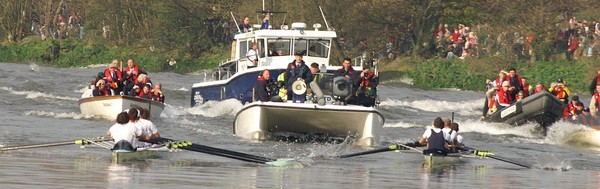
Picture of the 2007 race, umpired by Peter Bridge, via David Wilmot's Flickr stream.
Beyond the strict regulations that must be enforced, what is the scope for an umpire to bring a personal approach to their task?
Each umpire will have his own approach although we have all benefited from working together on the Umpires' Panel and learning from each other's thinking. For me it is important to develop a positive relationship with the crews based on the simple values of mutual trust and respect. Just as in football, rugby or any other sport, my aim has always been to be invisible and to let the athletes and the competition take centre stage.
How big a step would it be for an umpire to disqualify a crew?
Disqualification is the ultimate sanction and the umpire and both crews will be working to avoid the race ending in this way.
Beyond the well understood issues of stations and bends, what major considerations govern the tactics of a crew on the Boat Race Tideway course?
I have always considered one of the main tactical considerations to be the fact that it is a match race. It is about beating the crew next to you. Neither crew will want the other to gain an advantage or settle. It is a long race yet an early lead could be decisive so the crews set off at a sprint. Then, like in many sports, it is about performing to your best and applying pressure to the opposition. It is the umpire's job to let the race develop without interference.
What are the differences between rowing in the race today and when you took part yourself in 1982 and 1983?
On reflection there are more similarities than differences. We were students studying for degrees whilst spending long hours rowing and training. It is the same today. In recent years the clubs have developed much stronger management, coaching and support systems enabling the crews to row to even higher standards and attracting world class oarsmen to the race.